News
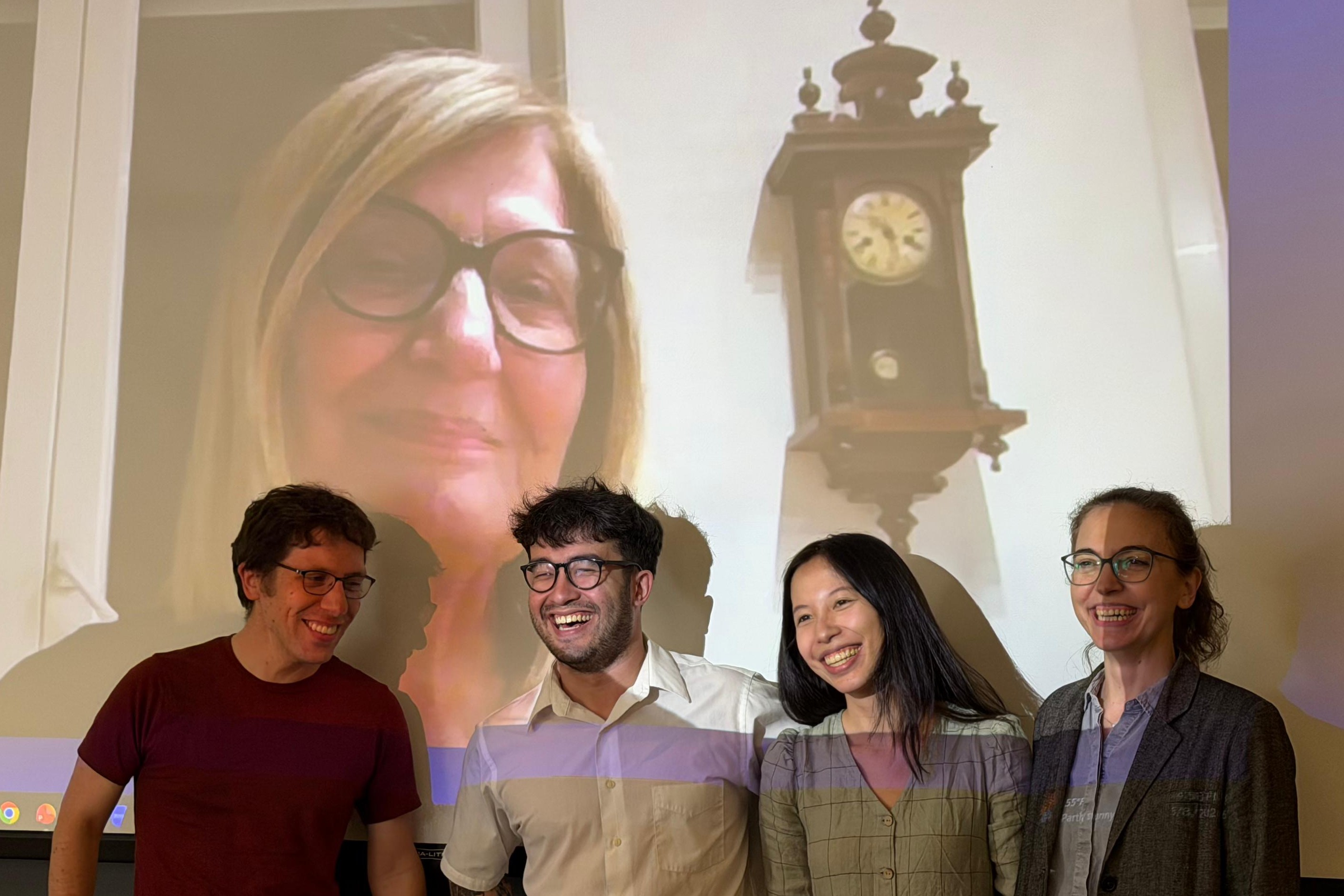
PhD Candidate John Starr successfully defends his dissertation
On Friday, May 8, 2026, PhD Candidate John Starr successfully defended his dissertation: Dynamic Interaction of Linguistic Streams During Processing - see the abstract below.
John is shown here with his dissertation committee -from the left, chair Dr. Marten van Schijndel, John Starr, and committee members Dr. Jennifer Kuo, Dr. Helena Aparicio, and on zoom Dr. Draga Zec.
Abstract:
It is well-established that people construct representations at multiple levels when processing linguistic input: for example, during and after reading "Where is my Capybara?", people develop phonological, syntactic, semantic, and discourse representations of the sentence and its components.
The primary focus of this thesis is understanding how people contextually use and prioritize these levels of representations, or streams, during both on-line and off-line processing. Through experiments on three phenomena (phonotactic distinctions, word order preferences for binomials, and rhyme), I show how these streams interface with one another, focusing on how phonological information is incorporated with linguistic structures that are more commonly studied in the sentence processing literature.
Broadly, my findings support a model of sentence processing that allows for dynamic, incremental interactions between levels of linguistic structure.
11th May 2026

PhD Candidate Chloe Kwon successfully defends her dissertation
On March 24, 2026 PhD Candidate Chloe Dokyung Kwon successfully defended her dissertation: Korean word-medial stops and compound tensification: Acoustic and perceptual studies - see the abstract below.
Chloe is shown here with her dissertation committee - co-chairs Drs. Sam Tilsen and Abby Cohn, and committee member Dr. John Whitman on Zoom.
Abstract:
This dissertation investigates word-medial stop realization in Korean through the lens of compound tensification — a process whereby a plain stop at the onset of the second noun in a noun-noun compound often surfaces as tense — through a production study of 32 speakers and a perception study of 94 listeners.
Acoustic analyses reveal that derived tense stops converge categorically on underlying tense stops rather than approximating them gradually, and that word-medial stop contrasts are maintained primarily through closure duration rather than the F0 and voice quality cues that predominate word-initially, suggesting a redistribution of acoustic correlates rather than positional weakening or merger. Listeners likewise rely on closure duration when categorizing medial stops; confidence ratings suggest sensitivity to phonological context, though this does not alter cue weighting.
Together, these findings disentangle categoriality and gradience in phonetic realization from variability, demonstrate that individual speaker variation is highly systematic and likely tracked by listeners, and suggest that positional differences in stop realization reflect differences in gestural timing relations rather than weakening or neutralization.
30th March 2026
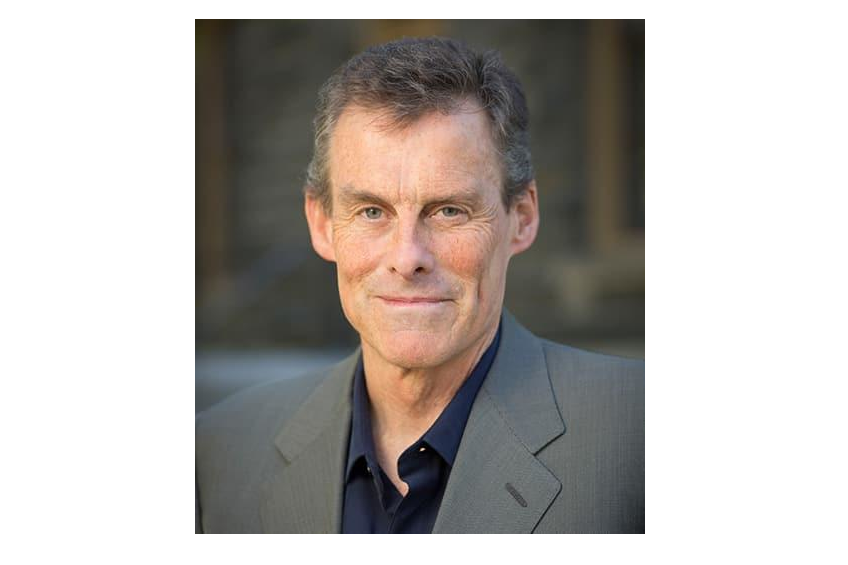
John Whitman receives Provost Award for Excellence in Teaching
Dr. John Whitman - Professor of Linguistics and a Phonetics Laboratory faculty member - has received a Cornell University Provost Award for Teaching Excellence in Graduate and Professional Degree Programs.
This award recognizes individuals who have demonstrated a record of teaching excellence at the graduate level that spans at least the past five years, and the nomination process includes letters of support from both faculty and students.
A former student described Whitman’s knowledge of linguistics as “seemingly infinite.”
In his nearly 40 years on the Cornell faculty, Whitman has provided deep knowledge and expertise in the classroom and as an adviser and mentor.
“In addition to his excellence in syntactic theory, Dr. Whitman’s dedication – especially with under-documented and endangered Indigenous languages – greatly enriches the available coursework within Cornell’s Department of Linguistics,” a current Ph.D. candidate wrote. “It was this work and support that helped me decide to attend Cornell instead of other top linguistic programs.”
As an adviser, Whitman is insightful and demanding, yet supportive and generous with his time. He connects students with other scholars in the field and readily writes letters of recommendation, provides thoughtful feedback and encourages students as they set out in their careers, nominators wrote.
“In both his teaching and advising, Professor Whitman exemplifies the best of graduate education,” a student wrote. “His ability to present complex materials clearly, foster independent thinking, and engage students with genuine intellectual curiosity makes him an exceptional teacher and mentor.”
2nd February 2026
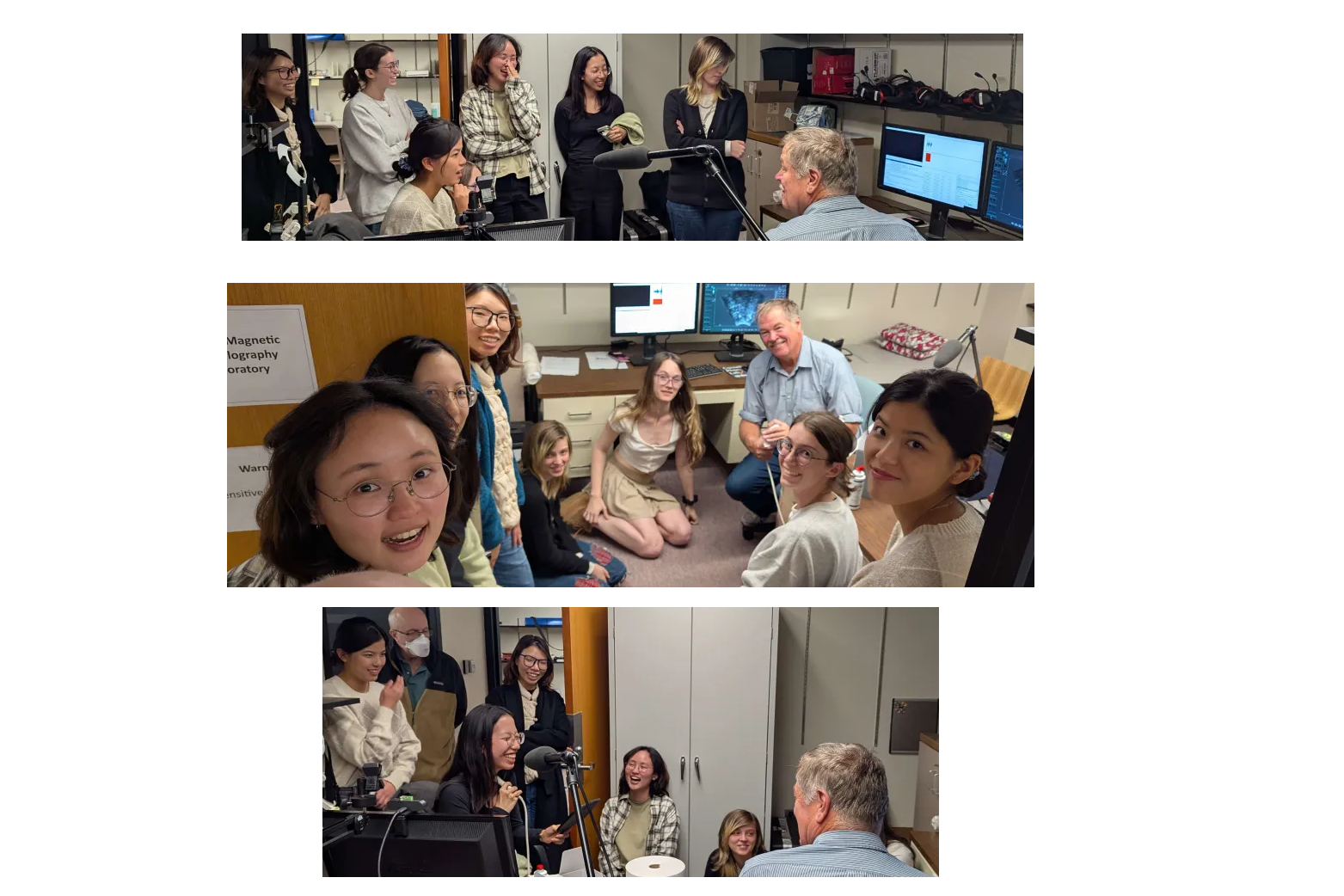
Dr. Mark Tiede visited the Phonetics Lab for a two-day workshop on ultrasonic imaging
On October 9 & 10, 2025, Dr. Mark Tiede from the Yale School of Medicine conducted an intensive two-day workshop on ultrasonic imaging techniques at the Phonetics Laboratory. The workshop, which combined theoretical instruction with hands-on experimentation, introduced participants to the practical aspects of imaging the human vocal apparatus in real-time.
The workshop's first day began in the Ultrasound Lab with comprehensive coverage of fundamental scanning parameters, including depth of field, sector angle, and frequency settings. Dr. Tiede demonstrated how these elements influence image quality and frame rates while addressing common challenges such as hyoid and mandibular shadowing.
The second day focused on more specialized applications. Topics included probe stabilization techniques using the ALPHUS system, co-collection of ultrasound data with intraoral EMA, and transverse laryngeal imaging for studying devoicing gestures. The workshop concluded with a pilot experiment in which workshop participants could see their own vocal fold vibrations in real time.
Everyone had fun and learned quite a bit over the two days, and a number of students will be applying Dr. Tiede's information to their own Phonetics lab ultrasonic imaging experiments in the coming months.
5th December 2025
©Copyright 2020, Cornell University