News
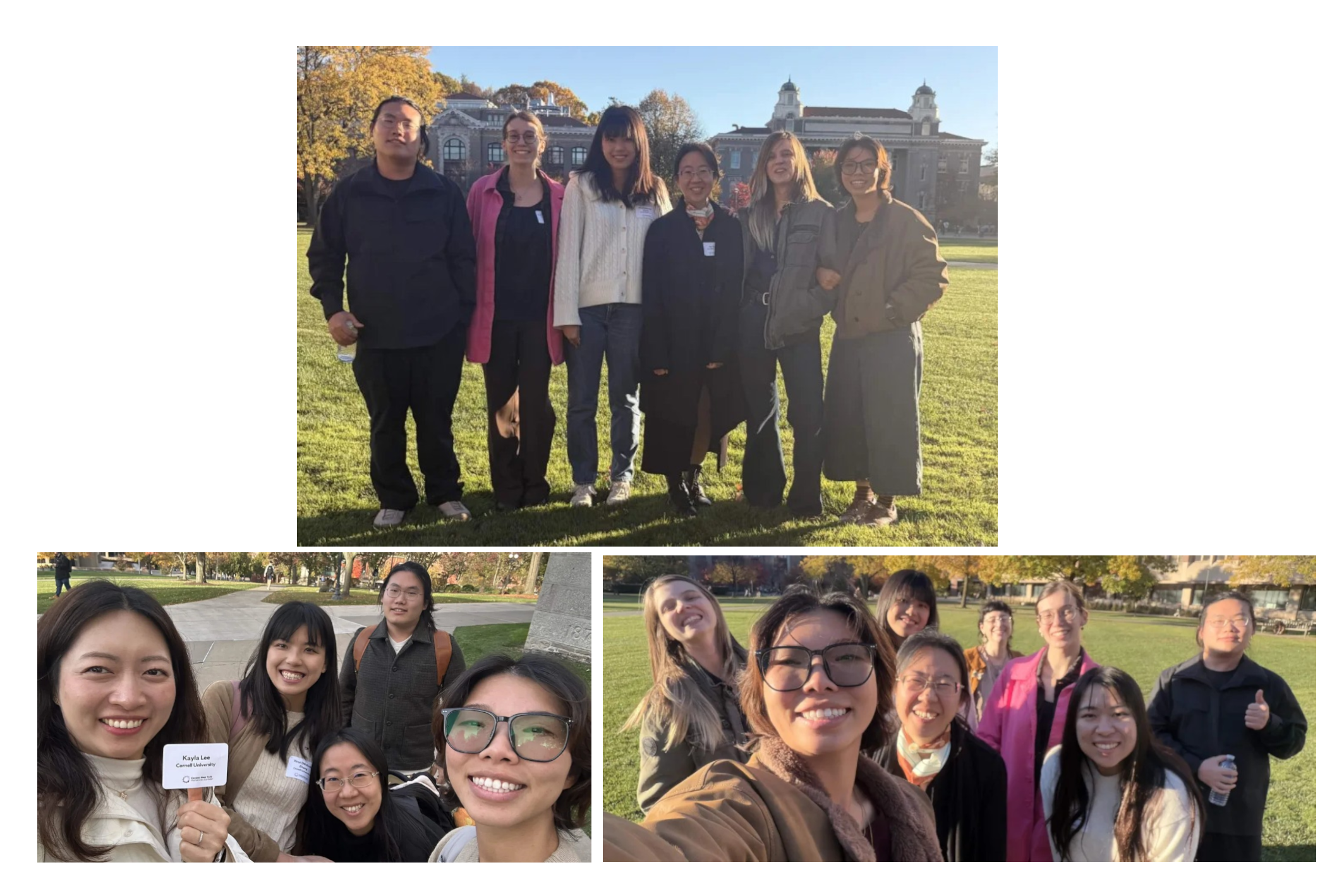
Phonetics Lab travels to Syracuse for the
The Phonetics Lab traveled to Syracuse, NY on Friday, October 23rd and Saturday, October 24th, 2026 for the for the two-day CNY Language Sound Structure Meeting of the LIN10 Workshop on Tone in Speech Corpora. LIN10 focuses on methodologies for studying tone in speech corpora, with a goal of discussing and debating current and newly developed tools and best practices in their implementation.
On Friday, Phonetics Lab faculty and grad students heard invited speaker Kathryn Franich (Harvard University) discuss tools developed in her lab to study tonal prominences and their intersection with speech rhythm. And on Saturday they heard short talks and roundtable discussions centered upon the workshop’s overarching theme of tonal phonology.
This workshop was funded and made possible by the CNY Humanities Corridor. More information can be found at https://www.cnycorridor.net/. We thank the CNY corridor for making this event possible. We are also grateful to Syracuse University's Department of Languages, Literatures, and Linguistics for making their spaces available for use during the event.
(Phonetics Lab members shown in the photos - Kayla (Kyunga) Lee, Xinyi (Melinda) Zhang, Yao Zhang, Xiaotian Liu, Fengyue (Lisa) Zhao, Annabelle di Lustro, and Faolan Boyd)
16th November 2026

Fengyue (Lisa) Zhao awarded a Hu Shih Fellowship
PhD Candidate Fengyue (Lisa) Zhao was recently awarded a Hu Shih Fellowship in Chinese Studies for her work on Mandarin Tone Production in Noise (see abstract below).
The Hu Shih Fellowship is awarded through Cornell's East Asia Program (EAP) to support graduate students conducting research related to East Asia.
This merit-based fellowship provides Fengyue (Lisa) financial support for one semester without teaching obligations, and allows her to focus full-time on her dissertation research.
The Hu Shih Fellowship in Chinese Studies is named after Cornell Alumnus Hu Shih (Class of 1914). Hu Shih was a Chinese citizen born in the later years of the Quing Dynasty, and was one of the early East Asian students at Cornell. Following graduation he served as the Chinese Ambassador to the United States from 1938 to 1942, and was the Chancellor of Peking University from 1946 to 1948. He was also active in Chinese linguistics and language issues and advocated using written vernacular Chinese in poetry and literature. For his contributions in this area, he was nominated for the 1957 Nobel Prize in Literature.
Abstract:
Mandarin Tone Production in Noise: Effects of Auditory Feedback Availability Across Native, Heritage, and English L2 Speakers
Speech production relies on the dynamic interplay between feedforward motor plans—internally generated motor commands that guide speech movements based on previously learned sensorimotor mappings—and auditory feedback, the process of monitoring one's own speech sounds to detect and correct errors during production.
However, how these two control systems interact in tonal languages and across speakers with different language experiences remains poorly understood. This project investigates how degraded auditory feedback affects Mandarin tone production and how reliance on feedback is shaped by speakers’ language backgrounds, focusing on native, heritage, and second-language learners.
While prior research shows that disrupting auditory feedback affects L2 speech more than native speech, most evidence comes from Western and non-tonal languages and rarely considers heritage speakers, whose early but variable exposure may yield distinct speech motor control strategies.
Through controlled acoustic and articulatory experiments, this study examines Mandarin tone production under normal and noise-masked feedback. By combining these manipulations with detailed language background questionnaires and fluency assessments, the project moves beyond categorical group comparisons to model how individual experience predicts sensitivity to feedback disruption.
The findings will advance theoretical accounts of motor control in tonal production, fill critical gaps in heritage language research, and generate empirically grounded insights for Mandarin pedagogy, particularly in heritage language education contexts.
23rd October 2026
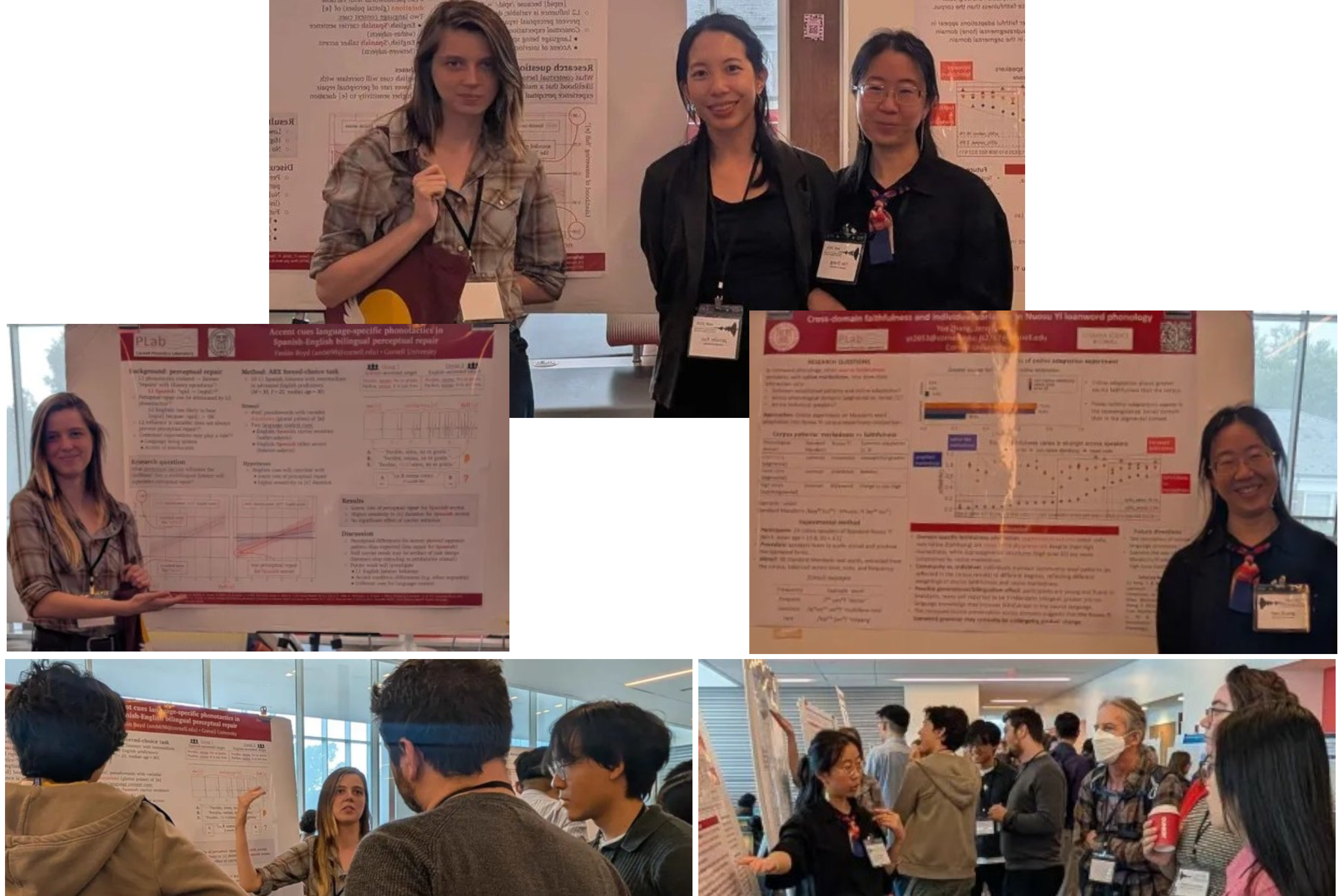
Jennifer Kuo, Yao Zhang, and Faolan Boyd present at AMP 2026
The Phonetics Lab was well represented at the Annual Meeting on Phonology (AMP) 2026, which was held from October 9-11, 2026 at the University of Maryland, College Park.
Assistant Professor Jennifer Kuo and PhD candidates Yao Zhang and Faolán Boyd presented the following posters:
- Evidence for the Maximum Onset Principle in morpheme segmentation; Dhanya Charan, Jennifer Kuo
- Source-language influence and cross- domain faithfulness in Nuosu Yi loanword phonology; Yao Zhang, Jennifer Kuo
- Accent cues language-specific phonotactics in Spanish-English bilingual perceptual re-pair; Faolán Boyd
(Photo caption - left to right - Faolán Boyd, Jennifer Kuo, Yao Zhang)
13th October 2026
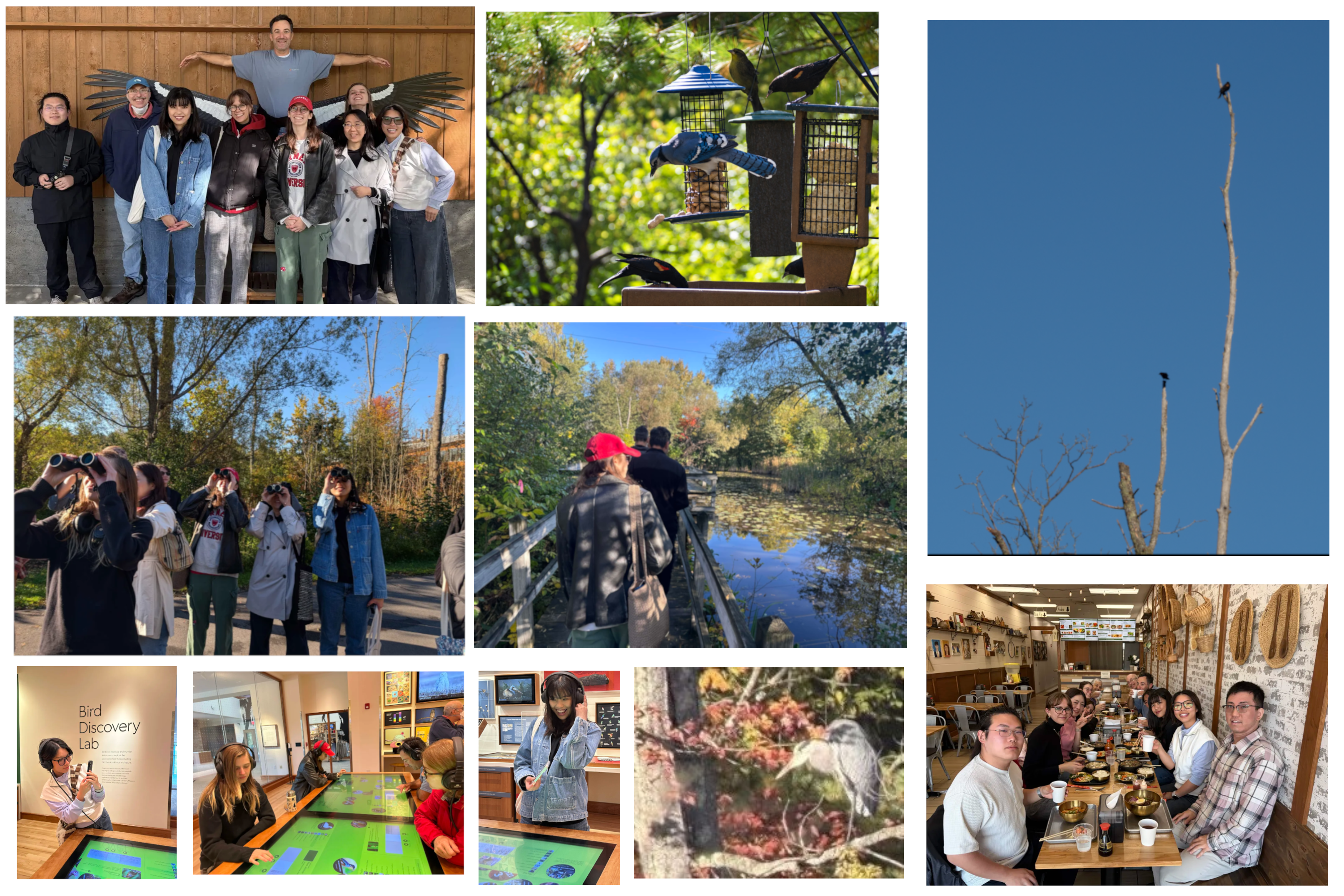
The Phonetics Lab Spends a Beautiful Fall Day Birding at Sapsucker Woods
On October 3, 2026 the Phonetics Lab spent a beautiful Fall Day birding at Cornell's Sapsucker Woods bird sanctuary. During our guided tour along the sanctuary trails, we got to traverse varied terrain and viewed (sometimes fleetingly!) a wide variety of native and migratory birds.
After the tour, we spent time at the adjacent Lab of Ornithology building, where we admired bird-related art and shopped at a very cute bird-themed gift shop. We also visited the Bird Discovery Lab, where we viewed exhibits on bird anatomy and spent way too much time at the interactive Bird Discovery table, where we listened to bird songs while viewing their real-time spectrograms.
Afterwards, we had a lunch at the excellent Ithaca Ole Ole Korean restaurant and its authentic Korean cuisine.
7th October 2026
©Copyright 2020, Cornell University